Founder of Beep Digital in Montreal and the voice of Hey/I, a one man show about AI, business and everyday life. Every episode is fact checked with numbered sources, and opinions are flagged as opinions.
Written by Danny Malouin. Published September 21, 2026. Last updated September 22, 2026.
Ask anyone what AI costs and they say twenty bucks. Ask them what they paid last month and watch them open their banking app. Then ask what their last laptop cost, what their Office subscription costs now versus two years ago, and how many evenings they spent teaching a chatbot to do a thing they used to just do. This episode is about all of those numbers, and about why they only go one way.
Hey / I
The price on the box is the smallest number in the story. The real cost of AI is a ladder. You climb it one easy rung at a time, and you never decide to. Then there is a second set of costs that never show up under “AI” on any statement: the software you already had, the computer you will have to replace, the hours you spend learning, the arguments at the dinner table. And underneath all of it there is a reason the ladder keeps getting taller. The stuff it runs on is not infinite.
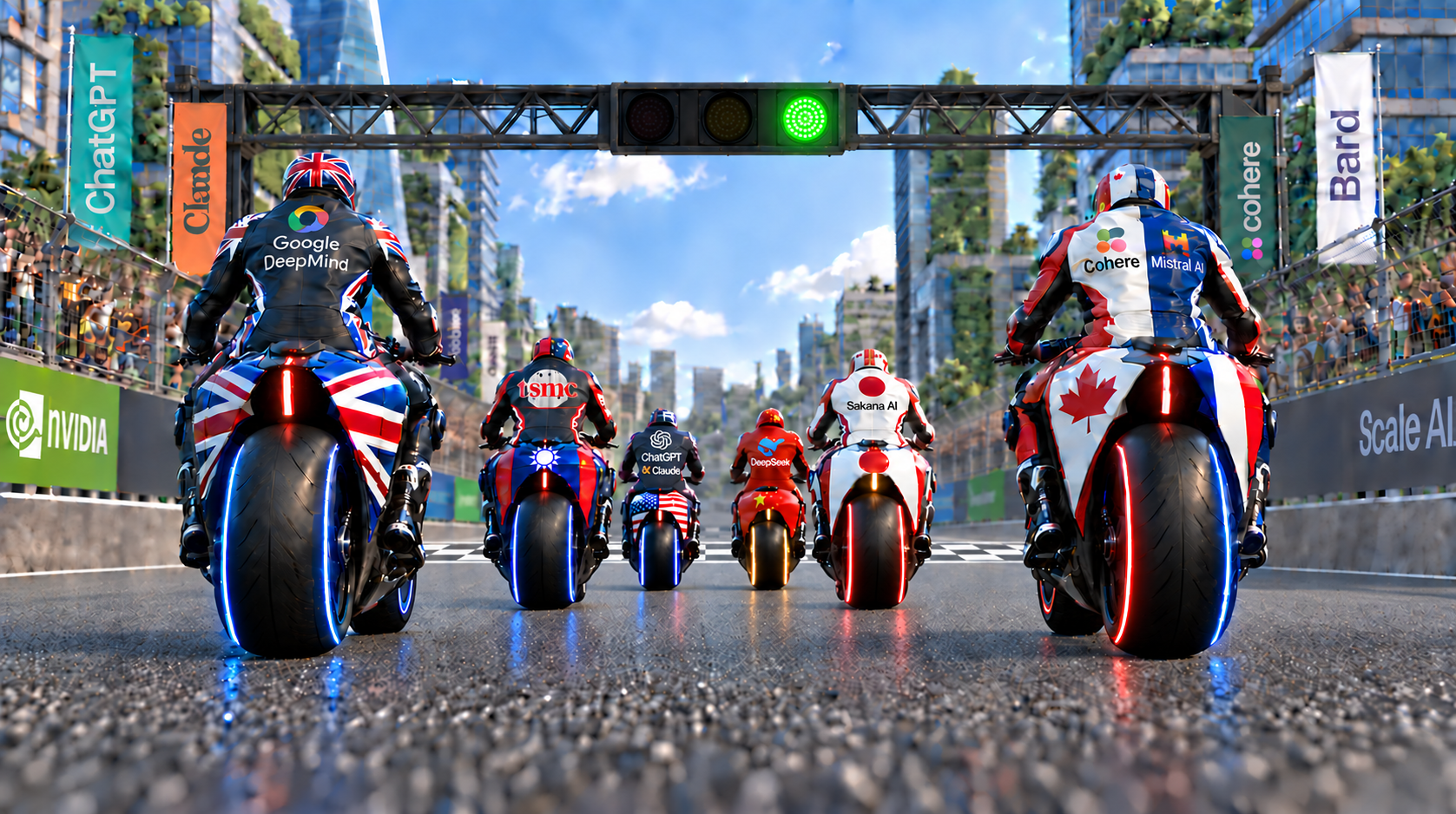
The three names you know are American and they all talk to you. That is the part of the race you can see, and it is the smallest part. Winning it is robots, chips, factories, trucks and labs, and a growing list of countries are already in those rooms. Nobody is guarding the exit.
Hey / I
Today’s question is simpler to ask than to answer. Who is actually building all this AI stuff?
Let me guess your answer. ChatGPT, Claude, Gemini. Maybe Copilot if you work in an office, maybe Grok if you spend too much time on X. All American. All headquartered within a two-hour drive of each other, Seattle excepted. And all of them, notice, are chatbots. Things you type at. Things that type back.
Here is the correction I want to make to your mental map, right away. The chatbot is the shop window. It is the most visible AI on earth because it is built to talk to you, one person at a time. That is also why it is the smallest part of the story.
The United States and China own that window. No argument. Between them they have the two best language models on the planet.
But AI is not a chatbot. It is reading factory parts in Stuttgart. Folding proteins in London. Etching every advanced chip in Taiwan on a machine from the Netherlands. Driving trucks out of a lab in Toronto. Shipping humanoid robots out of Hangzhou by the thousand. In those rooms, the board is crowded. A growing list of countries are not leading the race, but they are in it, close enough to matter.
One thing to hold onto for the whole read. Episode 0 ended on the idea that there is no off switch, because neither of the two biggest players will stop while the other keeps going. This episode is about why that was an understatement. It is not two players. The cat is not just out of the bag. There are cats on every continent.
What AI is when it isn’t talking to you
Before the tour, a quick widening of the definition, because the whole argument depends on it.
Think of AI as a store with six rooms. The first room is the one everyone knows. The other five are where most of the money, most of the jobs and most of the countries actually are.
Language
Room 1
The chatbots, translation, the customer-service bot that almost helped you last week. The room everyone knows.
Vision
Room 2
Reading a scan, inspecting a weld, watching a warehouse, seeing the road.
Prediction
Room 3
The quiet stuff inside every large company you deal with: demand forecasting, fraud detection, the grid deciding where your electricity comes from at 6 p.m.
The chips, the machines that make the chips, the memory, the data centres, the power. Everything under all of it.
The United States and China lead clearly in the first room and heavily in the sixth. In the four rooms in between, the leaders are often somewhere else entirely, and that is where “the U.S. is not alone” stops being a slogan and becomes a list of company names you have never heard of. The podiums in each room are my read of the board, opinion flagged as such, and the numbers behind them are in the tour below.
One honest caveat before we go. This board changes monthly. I am freezing it as of September 2026, and I am telling you so.
47.6740,-122.1215
Microsoft
USA (Redmond)
OpenAI’s biggest backer and landlord, and a frontier lab in its own right through Copilot and its own models.
37.7749,-122.4194
OpenAI – Anthropic – xAI – Meta
USA (San Francisco Bay)
The chatbot shop window. The three names most people know, all within a two hour drive of each other. Fifty notable models came out of the U.S. in 2025.
37.3541,-121.9552
Nvidia
USA (Santa Clara)
Designs the chips everyone is fighting over. Lost 589 billion dollars of market value in one day when DeepSeek landed in January 2025.
32.4487,-99.7331
Stargate data centres
USA (Abilene, Texas)
Where the 760 billion dollars a year of hyperscaler spending turns into buildings full of chips. Compute and money room.
43.6534817,-79.3839347
Cohere – Waabi
CANADA (Toronto)
Cohere anchors the 20 billion dollar Canadian German sovereign AI company and books over 240 million dollars a year. Waabi raised 750 million US dollars, the largest round in Canadian tech history, for driverless trucks.
45.5019,-73.5674
Bengio – LawZero – Mila
CANADA (Montreal)
Yoshua Bengio, Turing Award winner, now builds the brakes. LawZero received 300 million dollars from Canada and Germany in September 2026.
51.5072,-0.1276
Google DeepMind
UNITED KINGDOM (London)
Owned by Alphabet in the U.S., run from London. The AlphaFold protein folding work that won the 2024 Nobel Prize in Chemistry was done here.
52.2053,0.1218
Arm
UNITED KINGDOM (Cambridge)
Licenses the CPU architecture inside Nvidia’s Grace chips. The British flag on the chip.
51.4231,5.4016
ASML
NETHERLANDS (Veldhoven)
The only company on earth that makes the extreme ultraviolet lithography machines needed to etch the most advanced chips. Not the biggest. The only.
48.8566,2.3522
Mistral
FRANCE (Paris)
Europe’s frontier class language lab. Raised 3 billion euros at a 21 billion valuation in September 2026 and runs the French military’s AI on French infrastructure.
49.3988,8.6724
Aleph Alpha – Cohere
GERMANY (Heidelberg)
Merged with Toronto’s Cohere in April 2026 into a roughly 20 billion dollar sovereign AI company backed by the owners of Lidl and two governments.
47.3769,8.5417
AI research density
SWITZERLAND (Zurich)
More AI researchers per capita than any country on earth, per the Stanford AI Index 2026.
31.7683,35.2137
Mobileye
ISRAEL (Jerusalem)
The vision room. Driver assistance systems riding in more than 170 million cars, quite possibly yours.
24.4539,54.3773
G42 – Stargate UAE
UAE (Abu Dhabi)
If you cannot build the brains, buy the muscle. A one gigawatt OpenAI cluster and the first country to give ChatGPT to its entire population.
12.9716,77.5946
Sarvam
INDIA (Bangalore)
Not the lab, the market. Models in 22 Indian languages, backed by the IndiaAI Mission, for the 1.4 billion people ChatGPT was not built for.
1.3521,103.8198
GenAI adoption
SINGAPORE (Singapore)
Highest population adoption of generative AI anywhere, 61 percent. The United States sits at 28 percent, twenty fourth in the world.
39.9042,116.4074
Baidu – ByteDance – Moonshot – Zhipu
CHINA (Beijing)
The Chinese language model bench beyond DeepSeek. ByteDance, the TikTok people, builds Doubao. Thirty notable Chinese models shipped in 2025 on one twenty third of the American money.
37.2636,127.0286
SK Hynix – Samsung
SOUTH KOREA (Seoul area)
Two companies, 83 percent of the world’s high bandwidth memory. Every AI chip needs it stacked alongside. A room California cannot do without.
35.6762,139.6503
SoftBank
JAPAN (Tokyo)
Put 40 billion dollars into OpenAI, the largest single commitment in its history. Its founder chairs the Stargate project.
35.4500,138.8000
Fanuc – Yaskawa
JAPAN (Yamanashi and Kyushu)
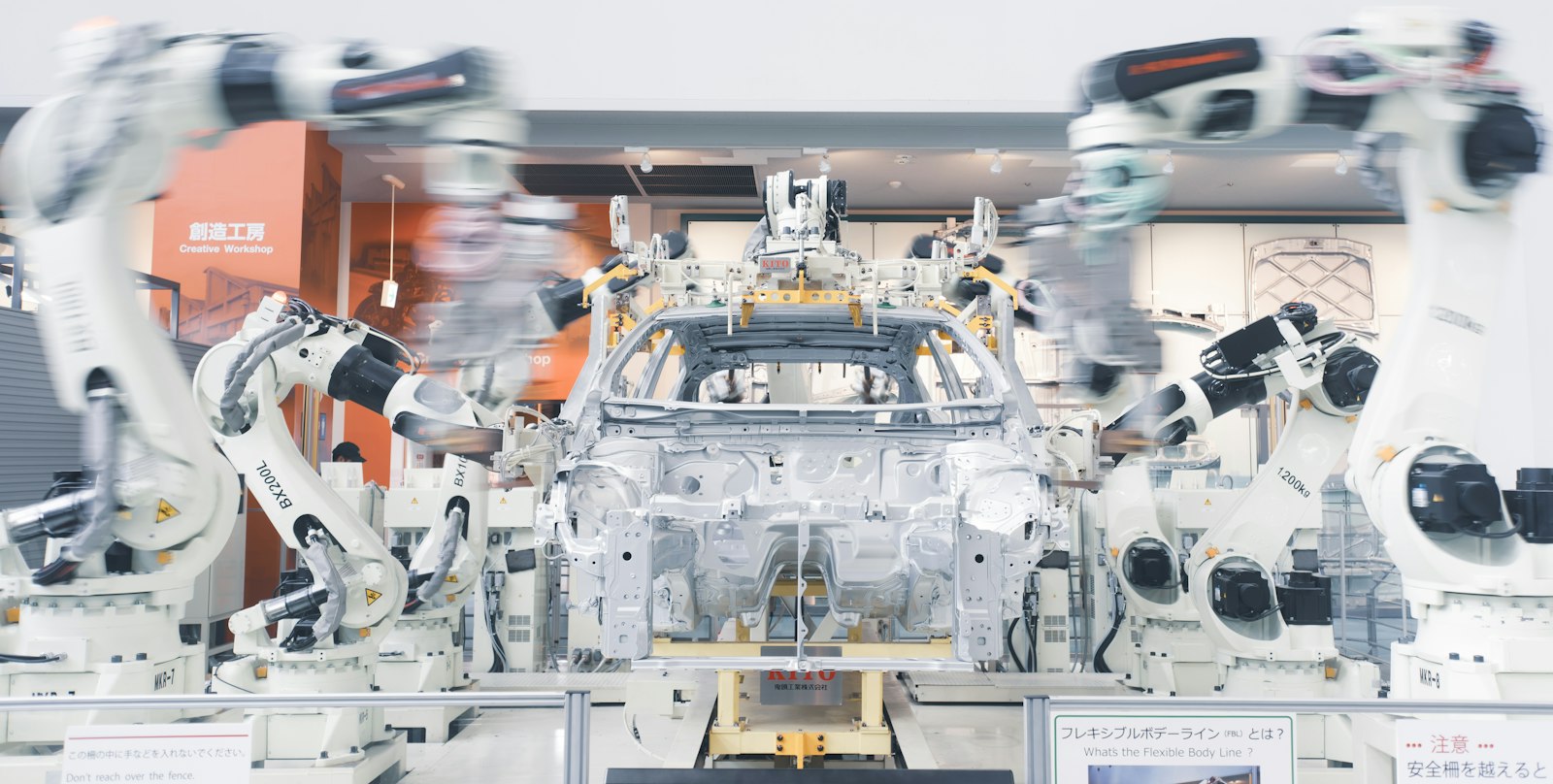
The arms on the world’s factory floors. Fanuc built its first robot in 1974, Yaskawa shipped Japan’s first all electric one in 1977.
30.2741,120.1551
DeepSeek – Alibaba Qwen
CHINA (Hangzhou)
DeepSeek matched the American frontier at a fraction of the cost. Qwen has been downloaded more than two billion times in 2026 with 151,000 derivative models. The cat, out of the bag, as a download count.
30.2941,120.1751
Unitree
CHINA (Hangzhou)
Shipped over 5,500 humanoid robots in 2025, about a third of the global market. Its stock rose 629 percent on its first day of trading in August 2026.
24.8138,120.9675
TSMC
TAIWAN (Hsinchu)
Roughly two thirds of the world’s advanced logic chip capacity, and nearly all of the very top tier. One island, one company, the single point of failure for the whole industry.
Language models
Robots & Automomy
Chips and Memory
Compute and Money
Science, vision and safety
THE TOP OF THE TABLE
The two leaders, and where their lead actually is
Let us give the two leaders their due first, together, so you can see them as the top of a table and not the whole table.
The American column you know. OpenAI, Anthropic, Google DeepMind (American owned, even if the lab sits in London, more on that below), Meta, xAI, and Microsoft, which is both a lab and OpenAI’s landlord. Underneath them, Nvidia designs the chips everyone is fighting over.
Then the money. The four hyperscalers are on track to spend around 760 billion US dollars on infrastructure this year, a number I covered last time and still cannot say out loud without pausing. And it is concentrated. Stanford’s 2026 AI Index counts 285.9 billion dollars of private AI investment in the United States in 2025. Seventy-six percent of it, 218 billion, landed in California alone.[1] Fifty notable models came out of the U.S. last year.[1]
Now the Chinese column, which most people can name exactly one entry in. DeepSeek is the one you know. On January 27, 2025 it wiped 589 billion dollars off Nvidia’s market value in a single day, the largest one-day loss for any company in history.[2] Behind it: Alibaba’s Qwen, ByteDance’s Doubao (yes, the TikTok people), Moonshot’s Kimi, Zhipu, Baidu, Tencent, MiniMax, StepFun.
Now the part that should bother the people spending 760 billion. China released thirty notable models in 2025, double the year before. The gap between the best American and the best Chinese model is down to 2.7 percent on the standard leaderboard, from as much as 31 points in 2023.[1]China did that on 12.4 billion dollars of private investment. Roughly one twenty-third of the American figure.[1] Read that sentence twice.
2 billion+
Qwen downloads in 2026
Alibaba’s open model family, downloaded more than two billion times this year.[3]
151,000
Derivative models
Copies and variations of Qwen in the wild, 4.7 times as many as Meta’s Llama.[3]
2.7%
Best US vs best Chinese model
The performance gap on the standard leaderboard, down from 31 points in 2023.[1]
And here is the number that matters most for this episode. Hugging Face is the site where the world’s open AI models live. In August 2026 it reported that Alibaba’s Qwen family has been downloaded more than two billion times this year, and has spawned over 151,000 derivative models, 4.7 times as many as Meta’s Llama.[3] In almost every month of 2026, the largest open model from a Chinese lab was bigger than anything an American lab put out in the open.[3]China did not choose to build the biggest chatbot. It chose cheap and everywhere. For a small business, the cheap one very often wins.
My read: the chatbot room is taken. The other five are up for grabs.
Opinion
Let’s be clear about the chatbot room first. The United States and China own it, and nobody is catching them there. The best model, the most users, the money. That room is decided.
The other five are not, and here is why. Qwen is open weights. Alibaba publishes the model file itself, and anyone can copy it and build on top of it. No permission, no bill.
2,000,000,000+ downloads this year
151,000 versions built on it by other people
Source: Hugging Face, August 2026
Nobody downloads Qwen to build a better chatbot. That fight is over. They download it to build the thing that reads the weld, runs the warehouse, folds the protein or drives the truck. A country no longer has to win the chatbot room to compete in the other five. It needs a room it already knows, and a free engine to put in it.
That is the race now. Not who builds the next ChatGPT. Who takes vision, prediction, robots, science and the infrastructure underneath, using engines the leaders gave away.
Kitchen-table version: your kid’s favourite apps may already run on Chinese models. TikTok and CapCut belong to ByteDance, the company behind Doubao. The chat window says nothing about who built what is behind it.
EUROPE
Not the chatbot, everything around it
Europe has spent three years being told it missed the boat. Here is what it actually has. One frontier-class language lab, which is one more than most continents. A dozen world leaders in the rooms the chatbot depends on. And the whistle.
The lab is Mistral, in Paris, three years old. On September 8, 2026 it raised three billion euros at a 21 billion valuation, with Samsung leading the round. Emmanuel Macron called the deal France and South Korea building “a third way in AI.”[4] In January the French Ministry of the Armed Forces signed a framework agreement to run Mistral’s models across the military and its research agencies, on French infrastructure rather than an American cloud.[5]Mistral’s pitch is not “we are smarter than OpenAI.” It is “we are not American.” In 2026 that is a product feature.
Germany is where it gets interesting for Canada. In April 2026, Toronto’s Cohere merged with Germany’s Aleph Alpha in a deal valued around 20 billion dollars. The Schwarz Group, the people who own Lidl, put in half a billion euros, and both governments stood behind it.[6]A Canadian-German sovereign AI company, selling to defence, energy, banks and hospitals that do not want their data routed through Microsoft or Google. More on Cohere below.
Mistral
France
€3 billion raised at a €21 billion valuation in September 2026, Samsung leading. Running the French military’s AI on French infrastructure.[4][5]
Aleph Alpha + Cohere
Germany
A roughly $20 billion Canadian-German sovereign AI company, backed by the owners of Lidl and two governments.[6]
DeepMind and AlphaFold
United Kingdom
The protein-folding work that won the 2024 Nobel Prize in Chemistry was done in London. The science room, not the chat room.[7]
ASML
Netherlands
The only company on earth that makes the extreme-ultraviolet machines needed to etch the most advanced chips. Not the biggest. The only.[8]
London gave the world DeepMind before Google bought it in 2014. That is why it sits in the American column above with an asterisk. The cheque is American, the brains are British. The AlphaFold work that won Demis Hassabis and John Jumper the 2024 Nobel Prize in Chemistry was done there.[7] Protein folding. The science room, not the chat room, and arguably the most useful thing any AI has done for a human being so far.
Then there is the Netherlands, home of the most important company most people have never heard of. ASML is the only company on earth that makes the extreme-ultraviolet lithography machines needed to etch the most advanced chips.[8] Every Nvidia chip, every Huawei workaround, every sovereign supercomputer on this map depends on a machine from a town called Veldhoven. That is why export controls work as a weapon.
Europe is also the referee. The EU AI Act is the world’s first comprehensive AI law. Its bans on the worst uses took effect in February 2025, its rules for general-purpose models in August 2025. In May 2026 Brussels pushed the heavier high-risk obligations back to December 2027 and August 2028. Even the people writing the rules cannot keep up.[9]
My opinion: Europe wants the whistle
Opinion
Europe is not trying to win the chatbot. It is trying to own the rooms the chatbot depends on, and to hold the whistle. Referees do not win matches. But nobody plays without them. When Ottawa eventually writes its own rulebook, it will look a great deal like the one from Brussels.
ASIA BEYOND CHINA
The hardware and the robots
If Europe holds the machine that makes the chips, Asia outside China holds almost everything else in the stack, and most of the robots.
Start with the robots, because it is the room the West most consistently underrates. The International Federation of Robotics counted 542,000 industrial robots installed worldwide in 2024, the second highest year on record. China installed 295,000 of them. Fifty-four percent of the world. Japan was second with 44,500, then the United States at 34,200, South Korea at 30,600, Germany at 27,000.[10] Asia took 74 percent of all new factory robots on the planet.
The arms in those factories are disproportionately Japanese. Fanuc built its first robot in 1974. Yaskawa shipped Japan’s first all-electric one in 1977, before most AI researchers were born.[29] And the humanoid robots you keep seeing in videos? Unitree, of Hangzhou, shipped over 5,500 of them in 2025, a third of the global market, and its stock rose 629 percent on its first day of trading in Shanghai this August.[11]The robot room is not an American room.
Now the memory. Every AI chip needs high-bandwidth memory stacked next to it. As of the second quarter of 2026, SK Hynix and Samsung make 83 percent of it.[12] Two South Korean companies. Korea is also running a national program to build its own foundation models, with Naver, LG, SK Telecom and others picked by the government in 2025.[13] A country of 52 million people is not going to out-spend California. It does not have to. It already owns a room the Californians cannot do without.
Taiwan is the room everyone knows and nobody likes to think about. TSMC holds roughly two-thirds of the world’s advanced logic chip capacity. At the very top tier, the 3-nanometre chips in the newest AI systems, it is closer to all of it.[14]One island. One company. The single point of failure for the entire industry, every country on this map included.
India is a different kind of player. Not the lab. The workforce and the market. OpenAI calls India its second-largest market. Sarvam, a Bangalore startup, released 30-billion and 105-billion-parameter models covering 22 Indian languages this spring, the first company backed by the government’s IndiaAI Mission.[15] India will not build the next ChatGPT. It is building the AI for the 1.4 billion people ChatGPT was not built for.
And the Gulf, which decided that if you cannot build the brains, you can buy the muscle. OpenAI’s first “Stargate” outside the United States is a one-gigawatt cluster in Abu Dhabi with G42, Oracle, Nvidia, Cisco and SoftBank. The first 200 megawatts come online this year. The UAE also became the first country to make ChatGPT available to its entire population.[16]Sovereign compute as national strategy, paid for in oil.
83%
South Korea
of the world’s high-bandwidth memory, the kind stacked next to every AI chip, made by SK Hynix and Samsung.[12]
Two-thirds
Taiwan
of advanced logic chip capacity at TSMC, and nearly all of it at the very top tier.[14]
5,500+
China
humanoid robots shipped by Unitree in 2025, about a third of the global market.[11]
One chip, six flags
Here is a way to see all of this at once. Picture one AI chip.
Designed
United States
in California, by Nvidia.
Architected
United Kingdom
on a CPU design licensed from Arm, in Cambridge.[31]
Stacked
South Korea
with high-bandwidth memory from SK Hynix or Samsung.[12]
Etched
Taiwan
at TSMC, the only place that can build the top tier at scale.[14]
On a machine
Netherlands
from ASML in Veldhoven. The only one that makes it.[8]
Installed
Texas, Abu Dhabi or Quebec
in a data centre wherever the power is cheap and the politics allow.
Six flags on one chip, and not one of those countries can make it alone.
CANADA
We built the engine and sold the car
Now the one that stings, told with pride and a raised eyebrow.
Remember the graph from Episode 0? The line crawls along the bottom for sixty-five years with a few small bumps. One of those bumps is 2012, the year a neural network called AlexNet won the ImageNet competition and started the modern deep learning era. I sourced it last time and moved on. What I did not say is where it came from. Geoffrey Hinton’s lab at the University of Toronto. The two students on the paper were Alex Krizhevsky and Ilya Sutskever.[17] Sutskever went on to co-found OpenAI.[18] The most famous American AI product in the world traces straight back to a Canadian lab.
That is not a fluke. The 2018 Turing Award, computing’s Nobel, went to Hinton, Yoshua Bengio of Montreal, and the Frenchman Yann LeCun for inventing the deep learning that runs every model on this map.[19] In 2024 Hinton won the actual Nobel Prize, in physics.[20] Two of the three people who invented modern AI did it in Toronto and Montreal. Canadians did not invent AI; that was Dartmouth in 1956, and I told you so in Episode 0. Canadians invented the version that works.
The engine
2012
AlexNet, from Hinton’s Toronto lab, wins ImageNet and starts the deep learning era. One of its authors goes on to co-found OpenAI.[17][18]
The medals
2018 and 2024
Hinton and Bengio share the Turing Award. Hinton adds the Nobel Prize in Physics.[19][20]
The sale
2020
Element AI, Montreal’s great hope, is sold to ServiceNow. The talent walks south.[30]
The comeback
2026
Cohere anchors a $20 billion sovereign AI company. Waabi raises $750 million US. Ottawa funds sovereign compute.[6][22][23]
Then we did what we do. Element AI, Montreal’s great hope, sold to ServiceNow, an American software company, in 2020.[30] The talent walked south. For a decade, the world’s best research fed other countries’ products. The Canadian small business “using AI” today is almost certainly renting American infrastructure and paying in U.S. dollars.
But the board has moved, and this is the part I did not expect to be able to write a year ago. Cohere, in Toronto, is now the anchor of that 20-billion-dollar Canadian-German company. In September it was reported to be raising two to three billion more, with the Canadian government participating. It books over 240 million dollars a year from banks, governments and defence firms that want an AI that is not American.[6][21]
Waabi, also Toronto, raised 750 million U.S. dollars in January, the largest funding round in Canadian tech history, to put driverless trucks on the road with Volvo and robotaxis on Uber.[22]Autonomy room, not chat room.
Ottawa is moving too. The two-billion-dollar Sovereign AI Compute Strategy has a national supercomputer funded and out for procurement, not yet built, and is paying for small businesses to buy compute.[23] In June the new Minister of Artificial Intelligence launched a national strategy with “Canadian sovereign AI” as one of its six pillars.[24]
And then there is the other thing Canada exports, which may matter more than any of it. The Canadians who built the engine are now the loudest voices in the world about the brakes. Hinton left Google to warn about what he had made, and puts the odds that AI leads to human extinction within thirty years at ten to twenty percent.[25] Bengio founded LawZero in Montreal to build what he calls a “Scientist AI,” a system designed to watch the other systems rather than act on its own. On September 16, 2026, the week I am writing this, Canada and Germany committed 300 million dollars to it. Asked whether estimates that AI could kill all humans within a decade were unrealistic, he answered, “No.”[26]
Sit with that. The two men who made this possible are spending the end of their careers trying to make it safe, and they are doing it from here.
My opinion: a research superpower and a commercial middleweight
Opinion
That gap is a choice we keep making. We are exactly the kind of country that can own two or three rooms if we decide to. Language through Cohere. Autonomy through Waabi. Safety through Bengio. And compute through the one resource we have that California does not: cheap hydro and cold weather. Whether we actually do it is on the ballot, whether anyone says so or not.
EVERYONE ELSE
The rest of the board, fast
Switzerland now has more AI researchers per capita than any country on earth.[1] Israel gave the world Mobileye, the vision system riding in more than 170 million cars, quite possibly yours.[27] Singapore has the highest population adoption of generative AI anywhere, 61 percent, with the UAE second at 54 percent; the United States sits at 28 percent, twenty-fourth in the world.[1] Japan’s SoftBank has put 40 billion dollars into OpenAI, the largest single commitment in its history, and its founder chairs the Stargate project.[28] Russia’s Yandex and Sber build for a domestic market largely cut off from Western chips. Brazil, Indonesia and a dozen others are building models for their own languages because nobody in California was going to do it for them.
The list keeps going. That is the point.
What the map tells you
Here is what I take from all of it, opinion clearly flagged.
Two countries lead the chatbot and the chip money, and their lead is real. Everywhere else, the store is crowded. Japan and Germany on the factory floor. Korea in memory. Taiwan and the Netherlands in the machines. London in science. Israel in vision. India in the market. The Gulf in the wallet. And Canada in the research that made all of it possible, and now in the brakes.
Most of these countries will never build the next ChatGPT. They do not need to. Owning one room is enough to matter to your supply chain, to your kid’s apps, and to your government’s leverage.
The part that feeds the unease I promised you
Opinion
In Episode 0 I said there was no off switch because two superpowers would not stop while the other kept running. I undersold it.
Count the players now. At least a dozen countries with a serious stake in one room or another. Tens of thousands of open-weight models already downloaded onto machines nobody controls. And two national plans I cited last episode, one literally titled “Winning the AI Race,” the other aiming to be “the world’s primary AI innovation center” by 2030.
Every credible voice worried about where this leads, to a system that outthinks us across the board, agrees on one thing. The danger is not that one lab gets there. It is that everyone is racing to get there first, and nobody can afford to slow down. The men who invented the technology are the ones saying so, from Toronto and Montreal. When the board was two players, you could at least imagine a phone call. It is not two players anymore.
That is the wow and the oh-no in one breath.
A crowded board
Wow
means cheaper, better, more varied tools for the corner store. And less dependence on six companies in one American state.
A crowded board
Oh no
means the tools you depend on are geopolitical assets on every continent. The rules can change with an election in a country you do not vote in. And the thing everyone is racing toward is something none of them fully understands.
Both are true. I am not going to resolve it for you.
What this means for you, this year
The chatbot is the least of it
If you run a small business
Ask where the boring wins are: forecasting, scheduling, invoice matching, inspection. Then ask two questions of every vendor. Which model is behind this, and where is my data stored. A cheap Chinese open model is a fine choice for drafting your newsletter and a bad idea for your customer list. Canadian-hosted options exist now for the sensitive stuff. Two years ago they did not.
The app is not the model
If you are a parent
Teach your kid to ask what is behind the chat window, the way you once taught them to ask who owns a website. Most of the AI they meet this year will not have a chat window at all.
We have the engine
If you are a Canadian who votes
We have the people trying to build the brakes. Compute, talent and data rules are choices, not weather. They are on the ballot even when nobody says the word.
That is the map. Next time we go into one room and stay there.
Facts in this article were checked against the sources above in September 2026. Where I offer an opinion, I say so in the text. Corrections will be posted here and in a pinned comment on the episode. Photo: Lilian Do Khac via Unsplash.
Written by Danny Malouin. Published September 14, 2026. Last updated September 22, 2026.
Seventy years of nothing much, then everything at once. The machine that was supposed to think by 1975 learned to talk in 2022, and it is now in your kid’s pocket, your accountant’s software and your government’s war room. Time for a human take.
Hey / I
Two words with a slash between them. That slash is where this show lives: somewhere between the human and the machine, between the people promising us paradise and the people warning us about the other place. I am not sold on either. I run a small digital business, I have kids, I use these tools every day, and I still cannot tell you where this is going. Neither can the people who built it, though they charge more for their guesses.
So before we react to anything, before we argue about jobs or homework or whether your fridge is spying on you, let us get the foundation right. Not the hype. Not the panic. The shape of the thing.
Because the shape is the story.
The shape of the line
Picture a graph. The horizontal axis runs from 1956 to this morning. The vertical axis is how much AI actually touches an ordinary human life.
For sixty-five years, the line does almost nothing. It crawls along the bottom of the chart like a hungover snake. Brilliant people, decades of work, two full collapses, a few headline victories that changed nothing at your kitchen table. If you had drawn that graph in 2019, you would have concluded that AI was a permanent laboratory curiosity, like fusion power or a functional Montreal pothole strategy.
Then, around 2022, the line stands up. Not a bump. A wall.
What the chart shows: how much AI touched an ordinary life stayed near zero from Dartmouth in 1956 through two AI winters, Deep Blue in 1997, ImageNet in 2012 and AlphaGo in 2016, then went vertical with ChatGPT in November 2022, 100 million users in two months and 900 million weekly users by 2026. Illustrative curve, not a measured series.
In numbers: time to reach 100 million users was 7 years for the World Wide Web, 4.5 years for Facebook, 2.5 years for Instagram, 9 months for TikTok and 2 months for ChatGPT.
Consider how long it took each of the big ones to reach 100 million people. The World Wide Web needed about seven years. Facebook, four and a half. Instagram, two and a half. TikTok, nine months. ChatGPT did it in two months.[1] And it kept going: by February 2026, a little over three years after launch, OpenAI said 900 million people were using ChatGPT every week, up from 800 million just four months earlier.[2]
The money followed the same curve. The four biggest American tech companies spent about 413 billion US dollars on capital expenditures in 2025, most of it on AI infrastructure. On their own guidance, they will spend around 760 billion in 2026.[3] In one year. That is close to two full years of everything the Canadian federal government spends, poured into buildings full of chips.
900 million
Every week
people using ChatGPT weekly as of February 2026, up 100 million in four months.[2]
$760 billion
This year
expected 2026 capital spending by Alphabet, Microsoft, Meta and Amazon, up from $413B in 2025.[3]
6.1% → 19.2%
In Canada
share of Canadian businesses using AI, Q2 2024 to Q2 2026. Tripled in two years.[4]
And it is not only the giants. Statistics Canada reported this June that 19.2 percent of Canadian businesses had used AI in the previous twelve months. Two years earlier, it was 6.1 percent.[4] Tripled. In two years. In Canada, where we take a decade to approve a bike lane.
Every technology that changed the world has a curve like this somewhere in its history. A long, boring fuse, then the explosion. What is different here is the ratio. The fuse was seventy years. The explosion has been about forty months, and it is still accelerating.
Nobody, not the researchers, not the regulators, not the people cashing the cheques, has ever had to absorb a change this large this quickly. When someone tells you they know how this ends, look at the graph. They are standing on a vertical line, pointing.
That is the feeling I want you to carry through everything that follows. Not fear. Vertigo. The healthy kind, the kind that makes you hold the railing.
Now let us look at this from all angles.
PART ONE
The seventy-year overnight success
Here is the first thing most people get wrong. Artificial intelligence did not show up in November 2022. It showed up in the summer of 1956, wearing a tie.
In August 1955, four researchers, John McCarthy, Marvin Minsky, Nathaniel Rochester and Claude Shannon, wrote a funding proposal for “a 2 month, 10 man study of artificial intelligence” to be held at Dartmouth College the following summer. That document is where the phrase artificial intelligence comes from. It stated, with the confidence of men who had never met a deadline, that “a significant advance can be made in one or more of these problems if a carefully selected group of scientists work on it together for a summer.”[5]
One summer. Ten guys. They were going to make a significant advance on machines that use language, form abstractions and improve themselves. To be fair to them, it was a very productive summer. It just turned out to be about seven decades long.
The predictions that followed have aged like milk in a hot car. In 1965, Herbert Simon, who would later win a Nobel Prize in economics, declared that “machines will be capable, within twenty years, of doing any work a man can do.” In 1970, Marvin Minsky told Life magazine that “in from three to eight years we will have a machine with the general intelligence of an average human being.”[6]
Three to eight years. From 1970. By that math, the average human being was supposed to be obsolete around the time Star Wars came out. Instead, we got the Pet Rock.
1955–56
The name is born
Four researchers propose a two-month, ten-man summer study at Dartmouth. The phrase “artificial intelligence” comes from that proposal.[5]
1965–70
The promises
Simon: any human work within twenty years. Minsky: a machine with average human intelligence in three to eight years.[6]
1970s & 1980s
Two winters
The 1973 Lighthill report and the collapse of “expert systems” each dry up the money for years.[7]
1997–2016
Narrow wins
Deep Blue beats Kasparov, AlexNet wins ImageNet, AlphaGo beats Lee Sedol. Impressive, and nothing changes at your kitchen table.[8][9][10]
This matters, and not just as a punchline. The pattern is not new. Brilliant researchers, thrilling demos, extravagant timelines, then a long stretch of nothing much. It is the oldest tradition in the field.
There were even names for the nothing-much stretches: the AI winters. The first arrived in the mid-1970s, after a British government review known as the Lighthill report concluded that AI had failed to deliver, and funding dried up on both sides of the Atlantic. The second came in the late 1980s, when the “expert systems” companies had spent fortunes on turned out to be expensive, brittle and about as flexible as a phone book.[7]
Twice already, the smartest people in the room told us the thinking machine was three to eight years away. Twice already, the money left the building. Anyone who tells you this time is different may well be right. But they should at least know the history, and most of the people selling it to you do not.
The wins did eventually come, just not the way the 1956 crowd imagined. In May 1997, IBM’s Deep Blue beat world chess champion Garry Kasparov.[8] In 2012, a neural network called AlexNet crushed the ImageNet image-recognition competition, and the modern “deep learning” era began in earnest.[9] In March 2016, DeepMind’s AlphaGo beat Lee Sedol, one of the best Go players alive, at a game people had said computers would not master for decades.[10]
Notice what those wins have in common. Chess. Image labelling. Go. Narrow, well-defined problems with clear rules and clear scores. Nobody’s job disappeared because a computer got good at Go. The machine was impressive. The world barely moved. That was the state of the art for most of the 2010s: very smart, very narrow, very far from your kitchen table. The line was still crawling.
Then somebody at Google wrote a paper with a title that sounds like a Beatles lyric.
In June 2017, eight Google researchers published “Attention Is All You Need,” introducing an architecture called the Transformer.[11] It was a new way for a machine to read a sequence of words and decide which of them matter to which other ones. It looked like a nice technical improvement for machine translation. It turned out to be the engine under every chatbot you have ever talked to. The T in GPT stands for Transformer.
OpenAI released ChatGPT to the public on November 30, 2022.[12] Within about two months it had an estimated 100 million monthly users, which analysts at UBS called the fastest adoption of any consumer application in history.[13]
My read on what actually changed
Opinion
It was not intelligence. The machine did not suddenly become smart. It suddenly became conversational. For seventy years AI was something that happened in labs and chess tournaments. Then one day it could talk back, in your language, about anything, and it was free.
That is the moment the fuse reached the powder. Every claim about AI stopped being an argument between experts and became an argument at your dinner table. Which is why this show exists.
PART TWO
The very confident autocomplete
Let us define the thing on your phone, because half the fear and all the hype depend on nobody doing that.
When people say “AI” today, they almost always mean a large language model: ChatGPT, Claude, Gemini, Copilot, the thing in your search engine that now answers before you finish asking.
Here is what a large language model actually is. A statistical system, trained on an enormous amount of text, that predicts which word is most likely to come next. Over and over, very fast, with a remarkable talent for sounding like a person. It is not looking things up. It is not reasoning the way you do. It has no idea whether what it just said is true. It has an idea of what sounds true, based on everything it has read.
That is the single most useful thing a regular person can know about AI, so let me put it in plainer words. The machine is a phenomenal pattern-matcher wearing a trench coat and pretending to be a librarian.
When the pattern in its training data lines up with reality, it is brilliant. Drafting an email. Summarizing a contract. Explaining your kid’s math homework four different ways until one lands.
When the pattern does not line up, it does not stop. It does not say “I don’t know.” It keeps going, fluently, confidently, and wrong. The industry calls this “hallucination,” which is a lovely word for “made it up.”
And this is not a bug a patch will fix next Tuesday. OpenAI itself published research last year explaining that hallucinations are a predictable result of how these systems are trained and scored. Models are rewarded for guessing rather than admitting uncertainty. Think of a student who leaves a multiple-choice question blank and gets zero, while the student who guesses might get lucky.[14] The machine has learned to guess. It is very good at it.
The right question is not “is it intelligent?”
Opinion
In my opinion, that is the question the utopians and the doomers both love, because it cannot be settled and it sells tickets. The right question for you and me is much more boring. What is it reliable for?
Right now, the honest answer is: things where you can check the output, or where being wrong is cheap. Draft the email, then read it. Summarize the document, then spot-check it. Do not let it file your taxes unsupervised. Do not let it be your kid’s doctor.
Treat it like a gifted, tireless, occasionally lying intern and you will get enormous value out of it. Treat it like an oracle and it will eventually embarrass you in public.
This is not another industrial revolution
You will hear the comparison constantly. “AI is the new electricity.” “It’s the industrial revolution of our time.” “It’s like when cars replaced horses.” I understand why people reach for those. They are comforting. We survived all of them. We even got weekends out of one.
But look at what each of those revolutions actually did.
Agriculture
Thousands of years
Changed how we get food. One kind of thing: growing.
Industry
About a century
Replaced human and animal muscle with steam and steel. One kind of thing: making.
The automobile
Roughly fifty years
From novelty to necessity. One kind of thing: moving.
Electricity
Decades
Took decades to reach most homes. One kind of thing: powering.
Each one was enormous. Each one replaced one kind of thing we do: growing, making, moving, powering. And each one gave a generation or two the time to adapt, to retrain, to write the laws, to build the schools, to argue about it at length and eventually get bored of arguing.
Here is where I leave the history books and give you my own view. AI is not one of those. AI is what you get when you take all of them and point them at the one thing none of them touched: thinking. Not muscle, not motion, not power. Judgment, language, decision, memory, creativity.
The industrial revolution did not write your emails. The automobile did not tutor your daughter, diagnose your X-ray, draft your contract, write your competitor’s marketing, screen your resume and clone your voice for a scammer, all in the same afternoon, using the same tool. AI does all of that today.
And it does it inside every previous revolution at once. The farm’s sensors, the factory’s robots, the car’s cameras, the grid’s controls. It is not a new industry sitting beside the others. It is a new layer soaking through all of them.
And it is arriving in years, not generations. The industrial revolution gave families a century to figure out what happened to the weavers. This one gave a 23-year-old about eighteen months to figure out what happened to the job they trained for. More on that below, with numbers.
That is why the comparisons fail. Not because AI is more powerful than steam, though it may be. Because it is broader, faster, and aimed at the part of us we thought was ours.
How big, right now
Those buildings full of chips eat. The International Energy Agency reports that data centres consumed about 415 terawatt-hours of electricity in 2024, roughly 1.5 percent of everything the world used, and projects that figure will more than double to around 945 TWh by 2030, a little more than the entire country of Japan uses today.[15]
In numbers: combined capital spending by Alphabet, Microsoft, Meta and Amazon was 413 billion US dollars in 2025 and is guided to about 760 billion for 2026.
In numbers: the share of Canadian businesses using AI to produce goods or deliver services went from 6.1 percent in the second quarter of 2024 to 12.2 percent in 2025 and 19.2 percent in 2026.
Hold the numbers together. 900 million people a week. 760 billion dollars a year. A Japan’s worth of electricity by 2030. That is not a gadget. That is infrastructure on the scale of the railways or the grid, being built at a speed the railways and the grid never managed.
And it is being built almost entirely by a handful of companies, mostly in one country, with their own money and therefore their own priorities. Whatever you think AI is for, the people paying 760 billion dollars a year have an opinion too. Theirs is the one the machines are being built to serve.
Now let us come home, because none of that is where AI actually touches your life.
Back to that Statistics Canada report. Of the 19.2 percent of Canadian businesses using AI, big companies lead at 27.8 percent. But the smallest businesses, one to four employees, are right behind at 19.9 percent. The most common uses are the least glamorous: analyzing data, analyzing text, running chatbots.
And the most common reason for not using it is not fear. Over 40 percent of the smallest businesses simply said it is not relevant to what they do. After that came privacy and cost.[4]
Read that from the corner store’s point of view. Four out of five Canadian businesses are not using AI. Nearly half of the small ones do not see the point. I do not think they are wrong to be cautious.
I think “not relevant” is the answer you give when nobody has shown you a relevant example. So far the examples have all been aimed at Fortune 500 companies with an innovation department. Nobody is making the case to the garage, the clinic or the restaurant. That is a gap. It is also, not coincidentally, my job.
And then there is the house. This June, Common Sense Media published its first annual census of AI use by American kids aged 9 to 17. Eighty-six percent of them use AI. Nearly a quarter use it every day. More than half of the ones who use it have asked it for advice about their health or their body. More than one in three have used it to talk about their feelings or personal problems.
Now the two numbers that matter. Only one third know that AI cannot reliably tell fact from fiction. And more than four in ten say no parent or guardian has ever talked to them about AI safety.[16]
86%
of kids aged 9–17 use AI; nearly a quarter every day.
1 in 3
have used it to talk about their feelings or personal problems.
Only 1 in 3
know AI cannot reliably tell fact from fiction.
4 in 10
say no parent or guardian has ever talked to them about AI safety.
Sit with that as a parent. Your kid has a tireless, agreeable, confident machine in their pocket. It will answer any question about their body and their feelings. They trust it more than they should. And you have probably never discussed it with them.
I am not saying this to scare you. Most of what kids do with it is homework and entertainment, and that is fine. I am saying it because “we should talk about AI” is now on the same shelf as “we should talk about the internet” was twenty years ago. We all remember how well that went when we skipped it.
Then there are the people using it against you. Canadians reported over 704 million dollars in fraud losses to the Canadian Anti-Fraud Centre in 2025, from more than 112,000 reports. A record. And the Centre has long estimated that only a small fraction of victims ever report.[17] Cybersecurity experts now say a convincing clone of someone’s voice can be made from about ten seconds of audio, which is less than your kid’s last voicemail.[18]The grandparent scam, where a caller pretends to be a relative in trouble, now comes with the relative’s actual voice.
Nobody put AI on the top ten fraud list, because AI is not a type of fraud. It is a productivity tool. It works for criminals exactly as well as it works for your accountant. Better, actually. Criminals do not worry about hallucinations.
PART THREE
The part where I admit nobody knows
This is the section every AI article gets wrong, because this is where the writer stops reporting and starts prophesying, and rarely tells you which is which. So I will tell you. The next few paragraphs are evidence. After that, I will warn you when I start guessing.
There is real, measurable evidence that AI is already reshaping who gets hired. Economists at Stanford’s Digital Economy Lab work from payroll data covering millions of American workers. In August they reported that employment among workers aged 22 to 25, in the occupations most exposed to AI, is now about 19 percent below where it would be if it had kept pace with their peers in less-exposed jobs. That gap was 15 percent a year earlier. It is widening.
The same researchers found no evidence of widespread displacement across the whole economy. Experienced workers in the same fields are fine. Jobs where AI assists people rather than replacing their tasks are stable or growing.[19]
So the honest headline is neither “AI is taking everyone’s job” nor “relax, nothing is happening.” It is more specific and more uncomfortable. The entry-level rung of the ladder, the first job where a 23-year-old learns how work actually works, is being sawed off in the fields where AI is strongest. The people already on the ladder are doing fine. Not the robot uprising. The missing first job. That is what the evidence shows today.
The evidence, though, only shows today.
The ladder, and why your job is not the exception
Here is where I move from the data to my own reading of it, and I want to be blunt, because I think most people are telling themselves a comforting story.
The comforting story goes like this: “Sure, AI will take some jobs. The boring ones. The clerks, the call centres, maybe the junior coders. But you will always need a real doctor. A real lawyer. A real electrician. Nobody is sending a chatbot to fix your furnace.”
And that story is true, in the narrowest possible sense. We will still need doctors in ten years. We will still need lawyers, electricians, plumbers and truckers.
We will just need a lot fewer of them.
Think about the ladder again. AI does not knock the whole thing over. It removes rungs. First the bottom one, which is what the Stanford data is showing us right now. The junior analyst, the first-year associate, the entry-level coder. The roles where a smart 23-year-old used to learn the trade by doing the grunt work.
Except the grunt work is exactly what the machine does best. So the firm hires one junior instead of five, and that one junior spends their day supervising the machine instead of learning the craft.
Now play the tape forward, because the machine gets better every few months and the rungs above are made of the same wood. A radiologist today reads scans. A radiologist in ten years signs off on scans the machine has already read, at ten times the speed. So a hospital needs one where it used to need several. A law firm that once needed forty associates to review documents needs four to check the machine’s review.
An accounting practice, an insurance office, a marketing agency, a newsroom, a pharmacy, a bank branch. Same shape, same math. The profession survives. The headcount does not. A thousand graduates walk out with the same degree their parents got and compete for a hundred jobs, most of which are titled something like “oversight” and pay accordingly.
And no, the trades are not the exception. They are just later in the queue. The electrician’s job is safe from a chatbot. It is not safe from the AI-driven diagnostics that turn a two-hour troubleshoot into a fifteen-minute swap, or from the building systems that phone in their own faults, or from the robotics already stacking shelves and pouring concrete.
The plumber is not being replaced this year. The number of plumbers a city needs, once every building can tell you exactly what is wrong before anyone shows up, is a different question. And truckers, one of the most common jobs for working men on this continent, are already watching it happen. Driverless trucks have been hauling paying freight across Texas without a human on board since May 2025, and the routes are multiplying.[24]
This is the piece the “your job is safe” crowd keeps missing. The question was never “can a machine do everything a doctor does?” The answer to that is no, probably for a long time. The question is “how many doctors does a hospital need once the machine does most of what a doctor does?”
And the honest answer, in my view, is: far fewer than we are currently training. That applies to nearly every field you can name. Not all at once, not on the same schedule, but all of them. And the schedule is shorter than anyone in the guidance counsellor’s office is admitting.
Which brings us back to the tug-of-war.
Two futures, both under construction
I want to be honest about the fight in my own head, because I think it is the fight in yours. Everything in this section is my reading, not a statistic.
The Wow
The Oh no!
The equalizer
Wow
A one-person business can now do the work of four. I have watched it. I have done it. The accountant, the designer, the translator, the customer-service desk, all for the price of a streaming subscription. For the corner store that has been getting crushed by chains with head offices, that is the first real equalizer in a generation.
No head office either
Oh no!
The same tool means the chain does not need its head office either. And the four people whose work my one-person business now does are looking for work. So is the junior who would have learned the trade at that head office. That is the 23-year-old in the Stanford data.
The 2 a.m. tutor
Wow
My kid can have a patient tutor at two in the morning that explains fractions six different ways and never sighs.
The 2 a.m. confidant
Oh no!
My kid can have a confident, agreeable machine at two in the morning that will tell her what it thinks she wants to hear about her body, her friends and her feelings, and one third of her generation knows it makes things up.
Superpowers for small shops
Wow
A small clinic can read a scan in seconds, a small law office can review a contract in minutes, a farmer can spot a sick plant from space.
Superpowers for everyone else
Oh no!
So can a scammer, a propagandist, and a stranger who wants ten seconds of your voice.
Cheaper every few months
Wow
This is the first technology in history that gets cheaper, faster and more capable every few months, and it is available to everyone.
Available to everyone
Oh no!
Including the people you would least like to have it. And it is getting cheaper, faster and more capable every few months, whether or not any of us has figured out what to do with the last version.
I am not going to resolve that for you. I cannot. Both lists are true today, not in some speculative future. Both are being built at the same time, by the same technology, often by the same companies. The version that wins in your life will depend far less on what the machine can do than on who is paying for it and whether you are paying attention.
There is no off switch
This is the part nobody likes to say out loud, so I will. Back to evidence for a moment.
AI is not just a product race between companies. It is a strategic race between countries, and the two biggest players have both said so in writing. China’s 2017 national plan set the goal of making China “the world’s primary AI innovation center” by 2030.[20] The United States has answered with export controls that block China from buying the most advanced AI chips,[21] with a national plan released in July 2025 whose actual title is Winning the AI Race,[22] and with the private spending spree described above. Nobody is being subtle.
In January 2025, a Chinese lab called DeepSeek released a model that matched the American frontier at a fraction of the cost, despite the chip restrictions, and rattled American markets. China has since ordered its state-funded data centres to use only domestic chips, and its newest models are being built for Chinese processors.
Analysts now describe two increasingly separate AI worlds, an American one and a Chinese one, with Europe, Japan, the Gulf states and India each trying to find a place between them.[23] Canada is in that middle group, whether we like it or not.
Think about what that does to the idea of slowing down. Every serious proposal to pause, to regulate hard, to take a breath, runs into the same wall. If we stop, they do not. If Washington slows down, Beijing does not. If Beijing slows down, Washington does not. If Ottawa or Brussels passes a strict law, the technology is built somewhere else and arrives anyway, through your phone, your bank, your kid’s apps.
Nobody is in charge of the whole line, and everyone on it believes falling behind is more dangerous than racing ahead. The people with the power to slow this down are precisely the people with the strongest reasons not to.
My conclusion, and it is mine
Opinion
There is no tangible way out of this. I do not say that as a doomer. I say it as a description of the map. There is no button, no treaty on the table, no election that stops the line.
The industrial revolution had no off switch either. But it also had no rival superpower racing to industrialize faster with the explicit goal of winning. This one does. That is the difference between a revolution and an arms race, and we are living in the second one while calling it the first.
The good news, and I am calling it good news on purpose, is that “no way out” is not the same as “no way through.” The people who did best in every previous revolution were never the ones who believed the sellers, or the ones who hid under the table. They were the ones who learned the tool early, kept their hand on their wallet, protected their kids, and stayed suspicious of anyone who was too certain. That is still available to you. It is, in fact, the whole reason for this show.
What this means for you, this year
Not in ten years. This year.
Try it on something boring
If you run a small business
Where you can check the result: drafts, summaries, the customer email you have been avoiding. Do not buy the platform with the AI badge until you can name the specific hour of your week it gives back. Ask every vendor who says “AI-powered” what, precisely, is powered, and by whom. One in five of your competitors is already doing this. Four in five are not. Both groups think they are right, and the line is not waiting for either of them.
Ask what they use it for
If you are a parent
Not as an interrogation, as a conversation. Then ask whether they know it makes things up. Two thirds of them do not. That one conversation puts you ahead of more than 40 percent of parents, which is a very low bar, and we should clear it.
Agree on a family code word
If you are anyone with a phone
Today. The kind of thing a scammer with ten seconds of your daughter’s voice could never know. It costs nothing. It sounds paranoid. So did locking your front door, once.
And if you are on the fence about all of this, good. Stay there. The fence is the only place you can see both sides of the line, and it is the only place this show will ever stand.
That is the foundation. Every episode from here on points back to it. Every claim we look at gets checked, every source gets listed, and every time I cross from what I know into what I think, I will say so. When I get one wrong, I will say that too, in a pinned comment, with a source.
Facts in this article were checked against the sources above in September 2026. Where I offer an opinion, I say so in the text. Corrections will be posted here and in a pinned comment on the episode. Photos: Zoshua Colah, F aint and Hassan Pasha via Unsplash.