HEY/I · EPISODE 1 · WHO IS BUILDING AI

The AI Race Will Not Be Won by the Best Chatbot

Written by Danny Malouin.
Published September 18, 2026. Last updated September 22, 2026.

The three names you know are American and they all talk to you. That is the part of the race you can see, and it is the smallest part. Winning it is robots, chips, factories, trucks and labs, and a growing list of countries are already in those rooms. Nobody is guarding the exit.
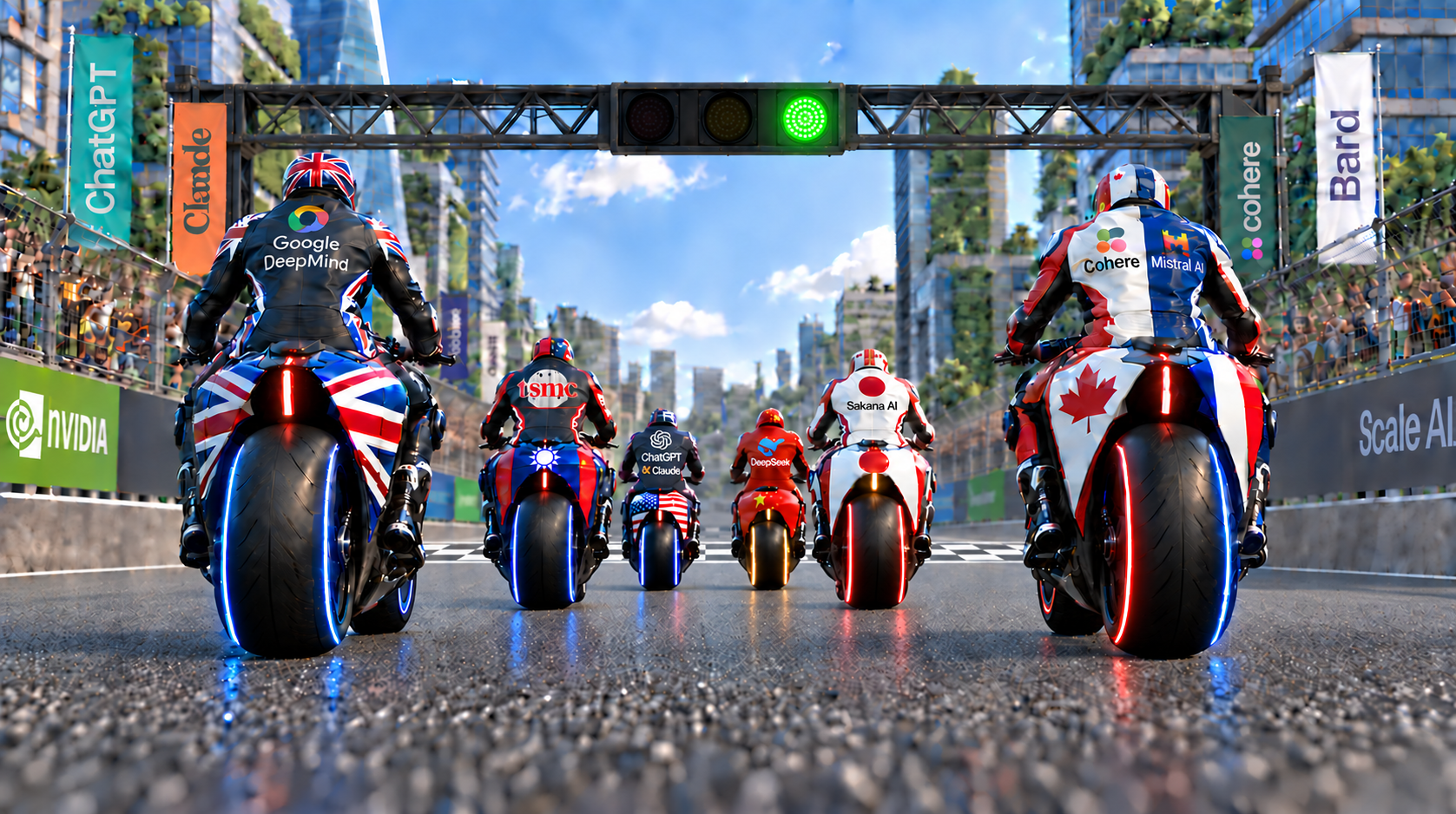
Six riders in national colours line up at the start of the AI race, Hey/I Episode 1 on Beep Digital

Hey / I

Today’s question is simpler to ask than to answer. Who is actually building all this AI stuff?

Let me guess your answer. ChatGPT, Claude, Gemini. Maybe Copilot if you work in an office, maybe Grok if you spend too much time on X. All American. All headquartered within a two-hour drive of each other, Seattle excepted. And all of them, notice, are chatbots. Things you type at. Things that type back.

Here is the correction I want to make to your mental map, right away. The chatbot is the shop window. It is the most visible AI on earth because it is built to talk to you, one person at a time. That is also why it is the smallest part of the story.

The United States and China own that window. No argument. Between them they have the two best language models on the planet.

But AI is not a chatbot. It is reading factory parts in Stuttgart. Folding proteins in London. Etching every advanced chip in Taiwan on a machine from the Netherlands. Driving trucks out of a lab in Toronto. Shipping humanoid robots out of Hangzhou by the thousand. In those rooms, the board is crowded. A growing list of countries are not leading the race, but they are in it, close enough to matter.

One thing to hold onto for the whole read. Episode 0 ended on the idea that there is no off switch, because neither of the two biggest players will stop while the other keeps going. This episode is about why that was an understatement. It is not two players. The cat is not just out of the bag. There are cats on every continent.

What AI is when it isn’t talking to you

Before the tour, a quick widening of the definition, because the whole argument depends on it.

Think of AI as a store with six rooms. The first room is the one everyone knows. The other five are where most of the money, most of the jobs and most of the countries actually are.

Blue map pin for language model companies on the Hey/I AI map
Room 1

Language

The chatbots, translation, the customer-service bot that almost helped you last week. The room everyone knows.

2CHINADeepSeek, Qwen1UNITED STATESOpenAI, Anthropic, Google, Meta3FRANCEMistral

Podium: United States first (OpenAI, Anthropic, Google, Meta), China second (DeepSeek, Qwen), France third (Mistral).

Purple map pin for science, vision and AI safety players on the Hey/I AI map
Room 2

Vision

Reading a scan, inspecting a weld, watching a warehouse, seeing the road.

2UNITED STATESTesla, Waymo, Nvidia1CHINACameras everywhere3ISRAELMobileye

Podium: China first (cameras everywhere), United States second (Tesla, Waymo, Nvidia), Israel third (Mobileye).

Dark teal generic map pin for the Hey/I AI map
Room 3

Prediction

The quiet stuff inside every large company you deal with: demand forecasting, fraud detection, the grid deciding where your electricity comes from at 6 p.m.

EVERY FLAG, NO WINNERRuns inside every company on earth

No podium: prediction and optimization AI runs inside every large company on earth, and no single country leads it.

Red map pin for robotics and autonomy companies on the Hey/I AI map
Room 4

Robotics and autonomy

Factory arms, warehouse robots, driverless trucks, drones.

2JAPANFanuc, Yaskawa1CHINA295,000 robots, Unitree3UNITED STATESTrucks and robotaxis

Podium: China first (295,000 robots installed in 2024, Unitree), Japan second (Fanuc, Yaskawa), United States third (trucks and robotaxis).

Purple map pin for science, vision and AI safety players on the Hey/I AI map
Room 5

Science

Protein folding, drug discovery, weather.

2UNITED STATESBaker lab, the money1UNITED KINGDOMDeepMind, AlphaFold3CANADAHinton, Bengio

Podium: United Kingdom first (DeepMind, AlphaFold), United States second (the Baker lab and the money), Canada third (Hinton, Bengio).

Teal map pin for chip and memory companies on the Hey/I AI map
Room 6

The stack

The chips, the machines that make the chips, the memory, the data centres, the power. Everything under all of it.

2TAIWANTSMC1UNITED STATESNvidia, the data centres3NETHERLANDSASML

Podium: United States first (Nvidia and the data centres), Taiwan second (TSMC), Netherlands third (ASML).

The United States and China lead clearly in the first room and heavily in the sixth. In the four rooms in between, the leaders are often somewhere else entirely, and that is where “the U.S. is not alone” stops being a slogan and becomes a list of company names you have never heard of. The podiums in each room are my read of the board, opinion flagged as such, and the numbers behind them are in the tour below.

One honest caveat before we go. This board changes monthly. I am freezing it as of September 2026, and I am telling you so.

Blue map pin for language model companies on the Hey/I AI map Language models, Red map pin for robotics and autonomy companies on the Hey/I AI map Robots & Automomy, Teal map pin for chip and memory companies on the Hey/I AI map Chips and Memory, Yellow map pin for compute and investment players on the Hey/I AI map Compute and Money, Purple map pin for science, vision and AI safety players on the Hey/I AI map Science, vision and safety
THE TOP OF THE TABLE

The two leaders, and where their lead actually is

Let us give the two leaders their due first, together, so you can see them as the top of a table and not the whole table.

The American column you know. OpenAI, Anthropic, Google DeepMind (American owned, even if the lab sits in London, more on that below), Meta, xAI, and Microsoft, which is both a lab and OpenAI’s landlord. Underneath them, Nvidia designs the chips everyone is fighting over.

Then the money. The four hyperscalers are on track to spend around 760 billion US dollars on infrastructure this year, a number I covered last time and still cannot say out loud without pausing. And it is concentrated. Stanford’s 2026 AI Index counts 285.9 billion dollars of private AI investment in the United States in 2025. Seventy-six percent of it, 218 billion, landed in California alone.[1] Fifty notable models came out of the U.S. last year.[1]

Private AI investment in 2025US$ billions. The performance gap between their best models: 2.7%United States$285.9BChina$12.4BSource: Stanford AI Index 2026 [1]

In numbers: private AI investment in 2025 was 285.9 billion US dollars in the United States and 12.4 billion in China, with a 2.7 percent performance gap between their best models.

Now the Chinese column, which most people can name exactly one entry in. DeepSeek is the one you know. On January 27, 2025 it wiped 589 billion dollars off Nvidia’s market value in a single day, the largest one-day loss for any company in history.[2] Behind it: Alibaba’s Qwen, ByteDance’s Doubao (yes, the TikTok people), Moonshot’s Kimi, Zhipu, Baidu, Tencent, MiniMax, StepFun.

Now the part that should bother the people spending 760 billion. China released thirty notable models in 2025, double the year before. The gap between the best American and the best Chinese model is down to 2.7 percent on the standard leaderboard, from as much as 31 points in 2023.[1] China did that on 12.4 billion dollars of private investment. Roughly one twenty-third of the American figure.[1] Read that sentence twice.

Qwen downloads in 2026
2 billion+
Alibaba’s open model family, downloaded more than two billion times this year.[3]
Derivative models
151,000
Copies and variations of Qwen in the wild, 4.7 times as many as Meta’s Llama.[3]
Best US vs best Chinese model
2.7%
The performance gap on the standard leaderboard, down from 31 points in 2023.[1]

And here is the number that matters most for this episode. Hugging Face is the site where the world’s open AI models live. In August 2026 it reported that Alibaba’s Qwen family has been downloaded more than two billion times this year, and has spawned over 151,000 derivative models, 4.7 times as many as Meta’s Llama.[3] In almost every month of 2026, the largest open model from a Chinese lab was bigger than anything an American lab put out in the open.[3] China did not choose to build the biggest chatbot. It chose cheap and everywhere. For a small business, the cheap one very often wins.

Danny Malouin

My read: the chatbot room is taken. The other five are up for grabs.

Opinion

Let’s be clear about the chatbot room first. The United States and China own it, and nobody is catching them there. The best model, the most users, the money. That room is decided.

The other five are not, and here is why. Qwen is open weights. Alibaba publishes the model file itself, and anyone can copy it and build on top of it. No permission, no bill.

2,000,000,000+ downloads this year
151,000 versions built on it by other people
Source: Hugging Face, August 2026

Nobody downloads Qwen to build a better chatbot. That fight is over. They download it to build the thing that reads the weld, runs the warehouse, folds the protein or drives the truck. A country no longer has to win the chatbot room to compete in the other five. It needs a room it already knows, and a free engine to put in it.

That is the race now. Not who builds the next ChatGPT. Who takes vision, prediction, robots, science and the infrastructure underneath, using engines the leaders gave away.

Kitchen-table version: your kid’s favourite apps may already run on Chinese models. TikTok and CapCut belong to ByteDance, the company behind Doubao. The chat window says nothing about who built what is behind it.

EUROPE

Not the chatbot, everything around it

Europe has spent three years being told it missed the boat. Here is what it actually has. One frontier-class language lab, which is one more than most continents. A dozen world leaders in the rooms the chatbot depends on. And the whistle.

The lab is Mistral, in Paris, three years old. On September 8, 2026 it raised three billion euros at a 21 billion valuation, with Samsung leading the round. Emmanuel Macron called the deal France and South Korea building “a third way in AI.”[4] In January the French Ministry of the Armed Forces signed a framework agreement to run Mistral’s models across the military and its research agencies, on French infrastructure rather than an American cloud.[5] Mistral’s pitch is not “we are smarter than OpenAI.” It is “we are not American.” In 2026 that is a product feature.

Germany is where it gets interesting for Canada. In April 2026, Toronto’s Cohere merged with Germany’s Aleph Alpha in a deal valued around 20 billion dollars. The Schwarz Group, the people who own Lidl, put in half a billion euros, and both governments stood behind it.[6] A Canadian-German sovereign AI company, selling to defence, energy, banks and hospitals that do not want their data routed through Microsoft or Google. More on Cohere below.


Mistral AI logo
France

Mistral

€3 billion raised at a €21 billion valuation in September 2026, Samsung leading. Running the French military’s AI on French infrastructure.[4][5]
Aleph Alpha logo
Germany

Aleph Alpha + Cohere

A roughly $20 billion Canadian-German sovereign AI company, backed by the owners of Lidl and two governments.[6]
Google DeepMind logo
United Kingdom

DeepMind and AlphaFold

The protein-folding work that won the 2024 Nobel Prize in Chemistry was done in London. The science room, not the chat room.[7]
ASML logo
Netherlands

ASML

The only company on earth that makes the extreme-ultraviolet machines needed to etch the most advanced chips. Not the biggest. The only.[8]

London gave the world DeepMind before Google bought it in 2014. That is why it sits in the American column above with an asterisk. The cheque is American, the brains are British. The AlphaFold work that won Demis Hassabis and John Jumper the 2024 Nobel Prize in Chemistry was done there.[7] Protein folding. The science room, not the chat room, and arguably the most useful thing any AI has done for a human being so far.

Then there is the Netherlands, home of the most important company most people have never heard of. ASML is the only company on earth that makes the extreme-ultraviolet lithography machines needed to etch the most advanced chips.[8] Every Nvidia chip, every Huawei workaround, every sovereign supercomputer on this map depends on a machine from a town called Veldhoven. That is why export controls work as a weapon.

Europe is also the referee. The EU AI Act is the world’s first comprehensive AI law. Its bans on the worst uses took effect in February 2025, its rules for general-purpose models in August 2025. In May 2026 Brussels pushed the heavier high-risk obligations back to December 2027 and August 2028. Even the people writing the rules cannot keep up.[9]

Danny Malouin

My opinion: Europe wants the whistle

Opinion

Europe is not trying to win the chatbot. It is trying to own the rooms the chatbot depends on, and to hold the whistle. Referees do not win matches. But nobody plays without them. When Ottawa eventually writes its own rulebook, it will look a great deal like the one from Brussels.

ASIA BEYOND CHINA

The hardware and the robots

If Europe holds the machine that makes the chips, Asia outside China holds almost everything else in the stack, and most of the robots.
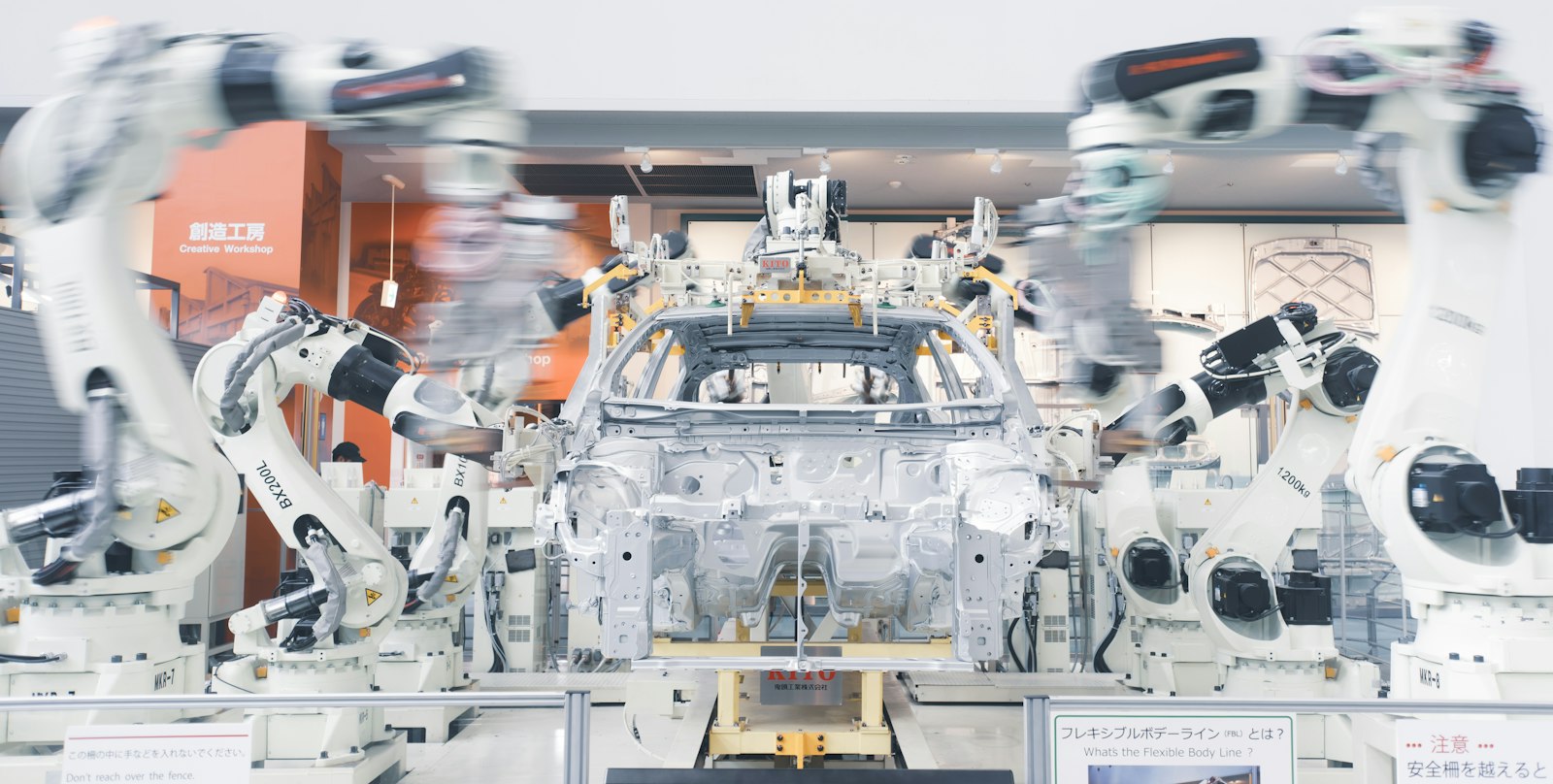
Robotic arms assembling a car chassis on a factory line

Start with the robots, because it is the room the West most consistently underrates. The International Federation of Robotics counted 542,000 industrial robots installed worldwide in 2024, the second highest year on record. China installed 295,000 of them. Fifty-four percent of the world. Japan was second with 44,500, then the United States at 34,200, South Korea at 30,600, Germany at 27,000.[10] Asia took 74 percent of all new factory robots on the planet.

The arms in those factories are disproportionately Japanese. Fanuc built its first robot in 1974. Yaskawa shipped Japan’s first all-electric one in 1977, before most AI researchers were born.[29] And the humanoid robots you keep seeing in videos? Unitree, of Hangzhou, shipped over 5,500 of them in 2025, a third of the global market, and its stock rose 629 percent on its first day of trading in Shanghai this August.[11] The robot room is not an American room.

Where the factory robots went in 2024New industrial robots installed, 542,000 worldwideChina295,000Japan44,500United States34,200South Korea30,600Germany27,000Source: International Federation of Robotics, World Robotics 2025 [10]

In numbers: of 542,000 industrial robots installed worldwide in 2024, China took 295,000, Japan 44,500, the United States 34,200, South Korea 30,600 and Germany 27,000.

Now the memory. Every AI chip needs high-bandwidth memory stacked next to it. As of the second quarter of 2026, SK Hynix and Samsung make 83 percent of it.[12] Two South Korean companies. Korea is also running a national program to build its own foundation models, with Naver, LG, SK Telecom and others picked by the government in 2025.[13] A country of 52 million people is not going to out-spend California. It does not have to. It already owns a room the Californians cannot do without.

Taiwan is the room everyone knows and nobody likes to think about. TSMC holds roughly two-thirds of the world’s advanced logic chip capacity. At the very top tier, the 3-nanometre chips in the newest AI systems, it is closer to all of it.[14] One island. One company. The single point of failure for the entire industry, every country on this map included.

India is a different kind of player. Not the lab. The workforce and the market. OpenAI calls India its second-largest market. Sarvam, a Bangalore startup, released 30-billion and 105-billion-parameter models covering 22 Indian languages this spring, the first company backed by the government’s IndiaAI Mission.[15] India will not build the next ChatGPT. It is building the AI for the 1.4 billion people ChatGPT was not built for.

And the Gulf, which decided that if you cannot build the brains, you can buy the muscle. OpenAI’s first “Stargate” outside the United States is a one-gigawatt cluster in Abu Dhabi with G42, Oracle, Nvidia, Cisco and SoftBank. The first 200 megawatts come online this year. The UAE also became the first country to make ChatGPT available to its entire population.[16] Sovereign compute as national strategy, paid for in oil.

South Korea
83%
of the world’s high-bandwidth memory, the kind stacked next to every AI chip, made by SK Hynix and Samsung.[12]
Taiwan
Two-thirds
of advanced logic chip capacity at TSMC, and nearly all of it at the very top tier.[14]
China
5,500+
humanoid robots shipped by Unitree in 2025, about a third of the global market.[11]

One chip, six flags

Here is a way to see all of this at once. Picture one AI chip.

United States

Designed

in California, by Nvidia.
United Kingdom

Architected

on a CPU design licensed from Arm, in Cambridge.[31]
South Korea

Stacked

with high-bandwidth memory from SK Hynix or Samsung.[12]
Taiwan

Etched

at TSMC, the only place that can build the top tier at scale.[14]
Netherlands

On a machine

from ASML in Veldhoven. The only one that makes it.[8]
Texas, Abu Dhabi or Quebec

Installed

in a data centre wherever the power is cheap and the politics allow.

Six flags on one chip, and not one of those countries can make it alone.

CANADA

We built the engine and sold the car

Now the one that stings, told with pride and a raised eyebrow.

Remember the graph from Episode 0? The line crawls along the bottom for sixty-five years with a few small bumps. One of those bumps is 2012, the year a neural network called AlexNet won the ImageNet competition and started the modern deep learning era. I sourced it last time and moved on. What I did not say is where it came from. Geoffrey Hinton’s lab at the University of Toronto. The two students on the paper were Alex Krizhevsky and Ilya Sutskever.[17] Sutskever went on to co-found OpenAI.[18] The most famous American AI product in the world traces straight back to a Canadian lab.

That is not a fluke. The 2018 Turing Award, computing’s Nobel, went to Hinton, Yoshua Bengio of Montreal, and the Frenchman Yann LeCun for inventing the deep learning that runs every model on this map.[19] In 2024 Hinton won the actual Nobel Prize, in physics.[20] Two of the three people who invented modern AI did it in Toronto and Montreal. Canadians did not invent AI; that was Dartmouth in 1956, and I told you so in Episode 0. Canadians invented the version that works.

2012

The engine

AlexNet, from Hinton’s Toronto lab, wins ImageNet and starts the deep learning era. One of its authors goes on to co-found OpenAI.[17][18]
2018 and 2024

The medals

Hinton and Bengio share the Turing Award. Hinton adds the Nobel Prize in Physics.[19][20]
2020

The sale

Element AI, Montreal’s great hope, is sold to ServiceNow. The talent walks south.[30]
2026

The comeback

Cohere anchors a $20 billion sovereign AI company. Waabi raises $750 million US. Ottawa funds sovereign compute.[6][22][23]

Then we did what we do. Element AI, Montreal’s great hope, sold to ServiceNow, an American software company, in 2020.[30] The talent walked south. For a decade, the world’s best research fed other countries’ products. The Canadian small business “using AI” today is almost certainly renting American infrastructure and paying in U.S. dollars.

But the board has moved, and this is the part I did not expect to be able to write a year ago. Cohere, in Toronto, is now the anchor of that 20-billion-dollar Canadian-German company. In September it was reported to be raising two to three billion more, with the Canadian government participating. It books over 240 million dollars a year from banks, governments and defence firms that want an AI that is not American.[6][21]

Waabi, also Toronto, raised 750 million U.S. dollars in January, the largest funding round in Canadian tech history, to put driverless trucks on the road with Volvo and robotaxis on Uber.[22] Autonomy room, not chat room.

Ottawa is moving too. The two-billion-dollar Sovereign AI Compute Strategy has a national supercomputer funded and out for procurement, not yet built, and is paying for small businesses to buy compute.[23] In June the new Minister of Artificial Intelligence launched a national strategy with “Canadian sovereign AI” as one of its six pillars.[24]

And then there is the other thing Canada exports, which may matter more than any of it. The Canadians who built the engine are now the loudest voices in the world about the brakes. Hinton left Google to warn about what he had made, and puts the odds that AI leads to human extinction within thirty years at ten to twenty percent.[25] Bengio founded LawZero in Montreal to build what he calls a “Scientist AI,” a system designed to watch the other systems rather than act on its own. On September 16, 2026, the week I am writing this, Canada and Germany committed 300 million dollars to it. Asked whether estimates that AI could kill all humans within a decade were unrealistic, he answered, “No.”[26]

Sit with that. The two men who made this possible are spending the end of their careers trying to make it safe, and they are doing it from here.
Danny Malouin

My opinion: a research superpower and a commercial middleweight

Opinion

That gap is a choice we keep making. We are exactly the kind of country that can own two or three rooms if we decide to. Language through Cohere. Autonomy through Waabi. Safety through Bengio. And compute through the one resource we have that California does not: cheap hydro and cold weather. Whether we actually do it is on the ballot, whether anyone says so or not.

EVERYONE ELSE

The rest of the board, fast

Switzerland now has more AI researchers per capita than any country on earth.[1] Israel gave the world Mobileye, the vision system riding in more than 170 million cars, quite possibly yours.[27] Singapore has the highest population adoption of generative AI anywhere, 61 percent, with the UAE second at 54 percent; the United States sits at 28 percent, twenty-fourth in the world.[1] Japan’s SoftBank has put 40 billion dollars into OpenAI, the largest single commitment in its history, and its founder chairs the Stargate project.[28] Russia’s Yandex and Sber build for a domestic market largely cut off from Western chips. Brazil, Indonesia and a dozen others are building models for their own languages because nobody in California was going to do it for them.

The list keeps going. That is the point.

Who actually uses generative AIShare of adult population using generative AISingapore61%United Arab Emirates54%United States (24th)28%Source: Stanford AI Index 2026 [1]

In numbers: 61 percent of adults in Singapore use generative AI, 54 percent in the United Arab Emirates, and 28 percent in the United States, which ranks 24th.

What the map tells you

Here is what I take from all of it, opinion clearly flagged.

Two countries lead the chatbot and the chip money, and their lead is real. Everywhere else, the store is crowded. Japan and Germany on the factory floor. Korea in memory. Taiwan and the Netherlands in the machines. London in science. Israel in vision. India in the market. The Gulf in the wallet. And Canada in the research that made all of it possible, and now in the brakes.

Most of these countries will never build the next ChatGPT. They do not need to. Owning one room is enough to matter to your supply chain, to your kid’s apps, and to your government’s leverage.

Danny Malouin

The part that feeds the unease I promised you

Opinion

In Episode 0 I said there was no off switch because two superpowers would not stop while the other kept running. I undersold it.

Count the players now. At least a dozen countries with a serious stake in one room or another. Tens of thousands of open-weight models already downloaded onto machines nobody controls. And two national plans I cited last episode, one literally titled “Winning the AI Race,” the other aiming to be “the world’s primary AI innovation center” by 2030.

Every credible voice worried about where this leads, to a system that outthinks us across the board, agrees on one thing. The danger is not that one lab gets there. It is that everyone is racing to get there first, and nobody can afford to slow down. The men who invented the technology are the ones saying so, from Toronto and Montreal. When the board was two players, you could at least imagine a phone call. It is not two players anymore.

That is the wow and the oh-no in one breath.

Wow

A crowded board

means cheaper, better, more varied tools for the corner store. And less dependence on six companies in one American state.
Oh no

A crowded board

means the tools you depend on are geopolitical assets on every continent. The rules can change with an election in a country you do not vote in. And the thing everyone is racing toward is something none of them fully understands.

Both are true. I am not going to resolve it for you.

What this means for you, this year

If you run a small business

The chatbot is the least of it

Ask where the boring wins are: forecasting, scheduling, invoice matching, inspection. Then ask two questions of every vendor. Which model is behind this, and where is my data stored. A cheap Chinese open model is a fine choice for drafting your newsletter and a bad idea for your customer list. Canadian-hosted options exist now for the sensitive stuff. Two years ago they did not.
If you are a parent

The app is not the model

Teach your kid to ask what is behind the chat window, the way you once taught them to ask who owns a website. Most of the AI they meet this year will not have a chat window at all.
If you are a Canadian who votes

We have the engine

We have the people trying to build the brakes. Compute, talent and data rules are choices, not weather. They are on the ballot even when nobody says the word.

That is the map. Next time we go into one room and stay there.

Hey. I. Talk soon.

SOURCES

Sources and further reading

  1. The Next Web: Stanford AI Index 2026, China narrows US lead to 2.7% while spending 23x less, April 19, 2026 (full report: Stanford HAI, The 2026 AI Index Report)
  2. CNBC: Nvidia sheds almost $600 billion in market cap, biggest one-day loss in U.S. history, January 27, 2025
  3. Hugging Face: State of Open Models, Summer 2026 Observations, August 14, 2026
  4. TechCrunch: Mistral raises €3B as sovereign AI becomes big business, September 8, 2026
  5. TechRepublic: Mistral AI wins French military framework agreement, January 2026
  6. TechCrunch: Why Cohere is merging with Aleph Alpha, April 25, 2026
  7. The Nobel Prize in Chemistry 2024: Baker, Hassabis, Jumper
  8. Works in Progress: ASML, the world's most complex lithography machine
  9. Gibson Dunn: EU AI Act Omnibus agreement, postponed high-risk deadlines, May 2026
  10. International Federation of Robotics: World Robotics 2025 report, September 25, 2025
  11. Xinhua: Chinese robot maker Unitree soars on Shanghai market debut, August 19, 2026
  12. Seoul Economic Daily: Samsung's HBM market share jumps to 33%, narrowing gap with SK hynix (Counterpoint Research, Q2 2026), September 3, 2026
  13. The Korea Times: 5 consortia selected to carry out Korea's national AI foundation model project, August 4, 2025
  14. SemiWiki / TechInsights: No, TSMC does not make 90% of advanced silicon
  15. Business Today: The Sarvam moment, March 16, 2026
  16. OpenAI: Introducing Stargate UAE, May 22, 2025
  17. Krizhevsky, Sutskever and Hinton, ImageNet Classification with Deep Convolutional Neural Networks, University of Toronto, 2012
  18. OpenAI: Introducing OpenAI, December 11, 2015
  19. ACM: 2018 Turing Award, Bengio, Hinton and LeCun
  20. The Nobel Prize in Physics 2024: Hopfield and Hinton
  21. The Globe and Mail via Investing.com: Cohere in advanced talks to raise up to $3 billion at $20 billion valuation, September 11, 2026
  22. BetaKit: Waabi claims largest-ever Canadian tech fundraise with $750 million USD Series C, partners with Uber on robotaxis, January 28, 2026
  23. Government of Canada: Canadian Sovereign AI Compute Strategy
  24. Government of Canada: Minister Solomon highlights Canada's National Artificial Intelligence Strategy, June 5, 2026
  25. Slashdot summary of BBC Radio 4 interview: Geoffrey Hinton says there is a 10 to 20% chance AI will lead to human extinction in 30 years, December 27, 2024
  26. BetaKit: Yoshua Bengio's LawZero receives $300 million backing from Canada and Germany, September 16, 2026
  27. Mobileye: EyeQ6 Lite launches to speed ADAS upgrades worldwide, more than 170 million vehicles, April 17, 2024
  28. CNBC: SoftBank has fully funded $40 billion investment in OpenAI, December 30, 2025
  29. Association for Advancing Automation: The Robotmakers, Yesterday, Today and Tomorrow, April 28, 2017
  30. ServiceNow: ServiceNow to Acquire AI Pioneer Element AI, November 30, 2020
  31. NVIDIA: Grace CPU, built on Arm Neoverse V2 cores

Facts in this article were checked against the sources above in September 2026. Where I offer an opinion, I say so in the text. Corrections will be posted here and in a pinned comment on the episode. Photo: Lilian Do Khac via Unsplash.